The International Journal of Digital Research (IJDR) has published a new research article examining how neuroscience-informed approaches can be integrated into blended and hybrid learning environments.
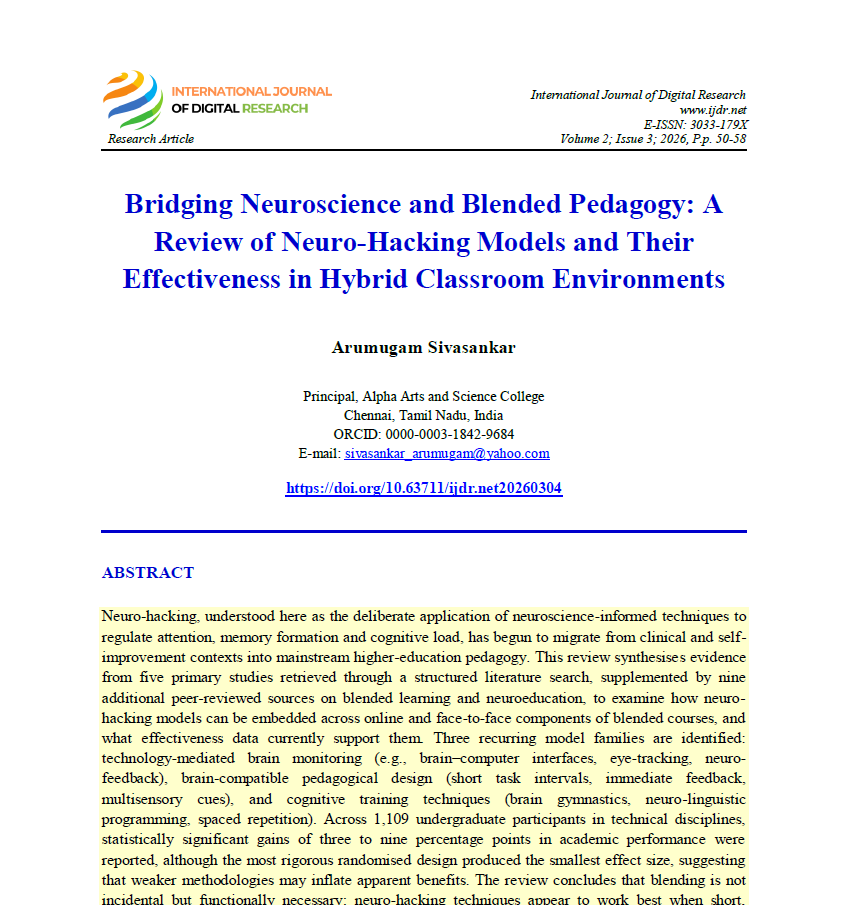
The article, “Bridging Neuroscience and Blended Pedagogy: A Review of Neuro-Hacking Models and Their Effectiveness in Hybrid Classroom Environments,” by Arumugam Sivasankar, explores the emerging intersection between neuroscience, educational technology, and blended pedagogy.
The study reviews existing evidence on the use of neuro-hacking approaches in higher education and identifies three recurring groups of techniques: technology-mediated brain monitoring, including brain–computer interfaces, eye-tracking, and neuro-feedback; brain-compatible pedagogical design, such as shorter learning intervals, immediate feedback, and multisensory cues; and cognitive training techniques, including spaced repetition and other approaches intended to support attention, memory, and learning.
Across the primary studies reviewed, involving 1,109 undergraduate participants in technical disciplines, improvements in academic performance ranging from three to nine percentage points were reported. At the same time, the review highlights an important limitation: the most rigorous randomized study produced the smallest effect, suggesting that stronger research designs are still needed before broad conclusions about effectiveness can be drawn.
The article therefore presents neuro-hacking not as a replacement for established teaching practices, but as an emerging set of neuroscience-informed tools that may complement blended pedagogy. It also emphasizes the need for further empirical research, particularly studies using rigorous experimental designs and examining longer-term educational outcomes.
By connecting neuroeducation, educational neuroscience, cognitive learning techniques, and blended learning, the study contributes to the growing discussion about how insights from neuroscience may inform the future design of technology-supported higher education.
Read the full article:
Bridging Neuroscience and Blended Pedagogy: A Review of Neuro-Hacking Models and Their Effectiveness in Hybrid Classroom Environments
DOI: 10.63711/ijdr.net20260304
Permanent archive: Zenodo