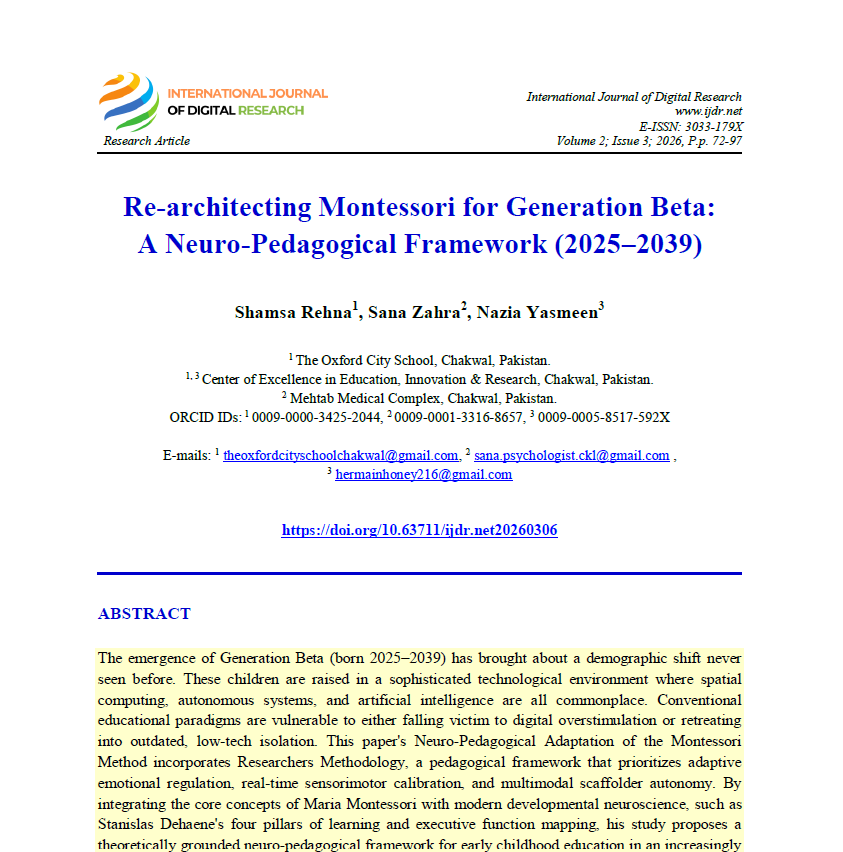
The International Journal of Digital Research (IJDR) has published a new research article exploring how Montessori education can be adapted to the emerging developmental and technological environment of Generation Beta.
The article, “Re-architecting Montessori for Generation Beta: A Neuro-Pedagogical Framework (2025–2039)”, is authored by Shamsa Rehna, Sana Zahra, and Nazia Yasmeen. It appears in Volume 2, Issue 3 (2026), pp. 72–97 of IJDR.
The study introduces a Neuro-Montessori framework that combines established Montessori principles with contemporary neuro-pedagogical approaches. The proposed model emphasizes three interconnected dimensions: somatic-executive alignment, technology-supported cognitive scaffolding, and emotional co-regulation. Rather than placing screens at the center of learning, the framework considers how ambient and minimally intrusive technologies could support physical, sensory, social, and independent learning.
A particular focus of the article is the educational environment facing Generation Beta (2025–2039). The authors discuss a childhood increasingly shaped by conversational AI, spatial computing, autonomous systems, predictive algorithms, and other forms of ambient digital technology. Against this background, they examine how early childhood education might benefit from technological innovation without sacrificing tactile experience, sustained attention, interpersonal interaction, and learner autonomy.
The article also presents a proposed 12-month multi-site randomized controlled study involving 240 children as a future empirical validation design for the Neuro-Montessori framework. Importantly, the proposed study has not yet been conducted, and the article therefore does not report empirical results or statistical significance from this proposed trial.
Beyond its conceptual contribution, the research offers a detailed implementation framework for educators, including classroom organization, daily routines, material manipulation protocols, observation instruments, student progress tracking, team-review procedures, and practical decision-making guidance. The authors ultimately argue for an approach in which technology supplements rather than replaces physical, sensory, social, and independent learning in early childhood education.
Article: Re-architecting Montessori for Generation Beta: A Neuro-Pedagogical Framework (2025–2039)
Authors: Shamsa Rehna, Sana Zahra, Nazia Yasmeen
Journal: International Journal of Digital Research, 2(3), 72–97
DOI: 10.63711/ijdr.net20260306
Research Areas: Neuroeducation, Early Childhood Education, Educational Technology