


The International Journal of Digital Research (IJDR) has reached out to more than 25,000 academicians and researchers across the globe in an effort to build connections and foster collaboration. Through this campaign, we invited scholars to publish and share their research with our international community.
IJDR Launches Donations
The International Journal of Digital Research (IJDR) is pleased to announce the launch of our Donations initiative. We warmly invite all who value science and research to support our journal. Your contribution will help us ensure stability, sustainability, and independence. While we rely primarily on APCs (Article Processing Charges), donations provide an additional way to strengthen our mission and keep IJDR accessible to the global academic community.
IJDR Now Listed on ResearchGate
We are excited to announce that the International Journal of Digital Research (IJDR) is now officially listed on ResearchGate’s journal list. Our articles are automatically indexed on their platform, ensuring wider visibility and accessibility.
IJDR Welcomes a New Editor
In August, the International Journal of Digital Research (IJDR) was delighted to welcome Dr. Antony Hoyte-West from Oxford, United Kingdom, to our editorial team.
IJDR Reaches 5,000+ Followers on Facebook!
We are excited to share that our community has now grown beyond 5,000 followers on Facebook! ❤️ Thank you for your support and trust in the International Journal of Digital Research (IJDR).
We Are Launching Our News Section!
We are happy to announce the launch of the News section at ijdr.net! Here, you will find the latest updates about our journal, including new article releases, upcoming calls for papers, editorial announcements, indexing progress, partnerships, and more.
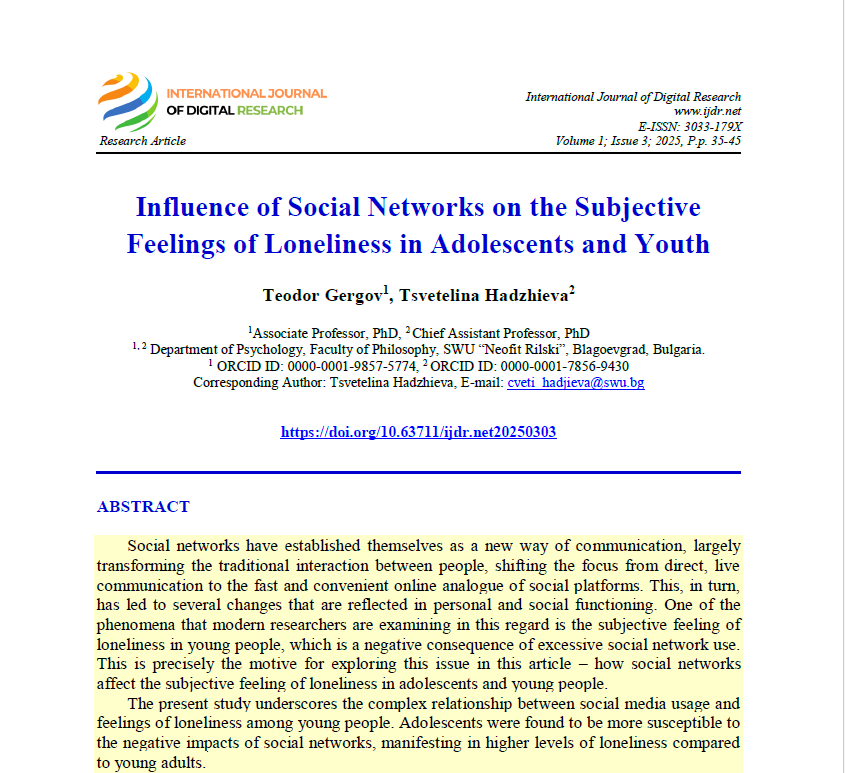
Influence of Social Networks on the Subjective Feelings of Loneliness in Adolescents and Youth
Teodor Gergov1, Tsvetelina Hadzhieva2 1 Associate Professor, PhD, 2 Chief Assistant Professor, PhD 1, 2 Department of Psychology, Faculty of Philosophy, SWU “Neofit Rilski”, Blagoevgrad, Bulgaria. 1 ORCID ID: 0000-0001-9857-5774, 2 ORCID ID: 0000-0001-7856-9430 Corresponding Author: Tsvetelina Hadzhieva, Е-mail: cveti_hadjieva@swu.bg Download https://doi.org/10.63711/ijdr.net20250303 ABSTRACT Social networks have established themselves as a new way of communication, largely transforming the traditional interaction between people, shifting the focus from direct, live communication to the fast and convenient online analogue of social platforms. This, in turn, has led to several changes that are reflected in personal and social functioning. One of the phenomena that modern researchers are examining in this regard is the subjective feeling of loneliness in young people, which is a negative consequence of excessive social network use. This is precisely the motive for exploring this issue in this article – how social networks affect the subjective feeling of loneliness in adolescents and young people. The present study underscores the complex relationship between social media usage and feelings of loneliness among young people. Adolescents were found to be more susceptible to the negative impacts of social networks, manifesting in higher levels of loneliness compared to young adults. Keywords: Social networks, Information channels, Loneliness, Adolescents, Young people Research Area: Psychology Copyright © 2025 The Author(s). This article is licensed under CC BY 4.0.
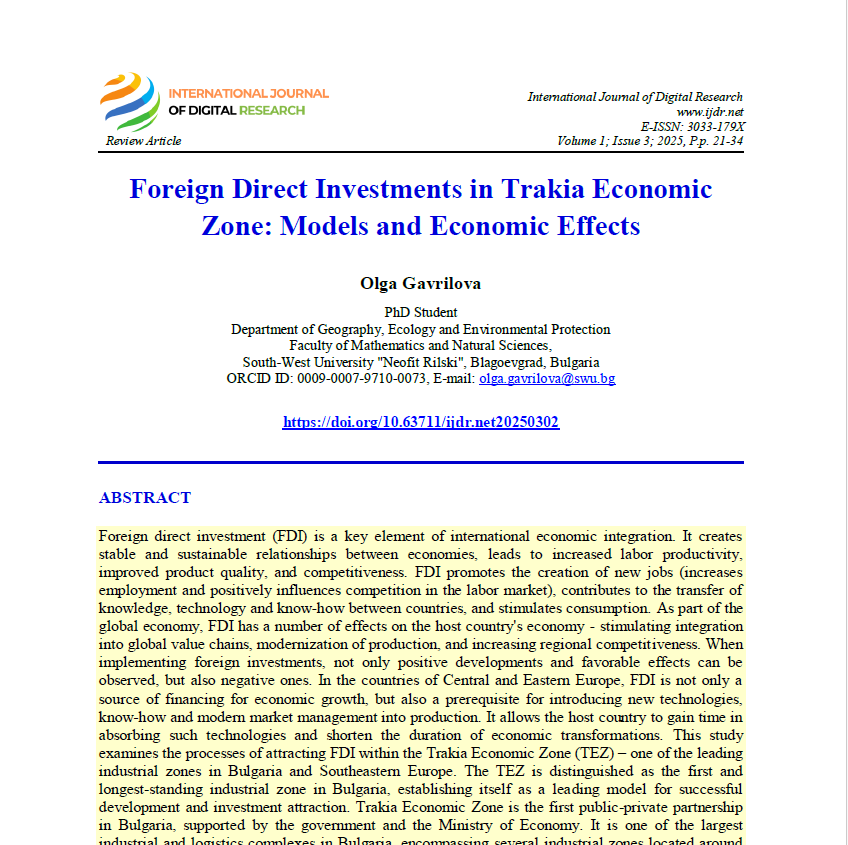
Foreign Direct Investments in Trakia Economic Zone: Models and Economic Effects
Olga Gavrilova PhD Student Department of Geography, Ecology and Environmental Protection Faculty of Mathematics and Natural Sciences, South-West University “Neofit Rilski”, Blagoevgrad, Bulgaria ORCID ID: 0009-0007-9710-0073, E-mail: olga.gavrilova@swu.bg Download https://doi.org/10.63711/ijdr.net20250302 ABSTRACT Foreign direct investment (FDI) is a key element of international economic integration. It creates stable and sustainable relationships between economies, leads to increased labor productivity, improved product quality, and competitiveness. FDI promotes the creation of new jobs (increases employment and positively influences competition in the labor market), contributes to the transfer of knowledge, technology and know-how between countries, and stimulates consumption. As part of the global economy, FDI has a number of effects on the host country’s economy – stimulating integration into global value chains, modernization of production, and increasing regional competitiveness. When implementing foreign investments, not only positive developments and favorable effects can be observed, but also negative ones. In the countries of Central and Eastern Europe, FDI is not only a source of financing for economic growth, but also a prerequisite for introducing new technologies, know-how and modern market management into production. It allows the host country to gain time in absorbing such technologies and shorten the duration of economic transformations. This study examines the processes of attracting FDI within the Trakia Economic Zone (TEZ) – one of the leading industrial zones in Bulgaria and Southeastern Europe. The TEZ is distinguished as the first and longest-standing industrial zone in Bulgaria, establishing itself as a leading model for successful development and investment attraction. Trakia Economic Zone is the first public-private partnership in Bulgaria, supported by the government and the Ministry of Economy. It is one of the largest industrial and logistics complexes in Bulgaria, encompassing several industrial zones located around the city of Plovdiv. The report analyzes investment patterns, the profile of foreign companies, as well as the economic effects of FDI on the socio-economic development of the region. Keywords: Foreign direct investment, Trakia economic zone, Economic effects, Investment models Research Area: Economic Geography, Regional Economics Copyright © 2025 The Author(s). This article is licensed under CC BY 4.0.
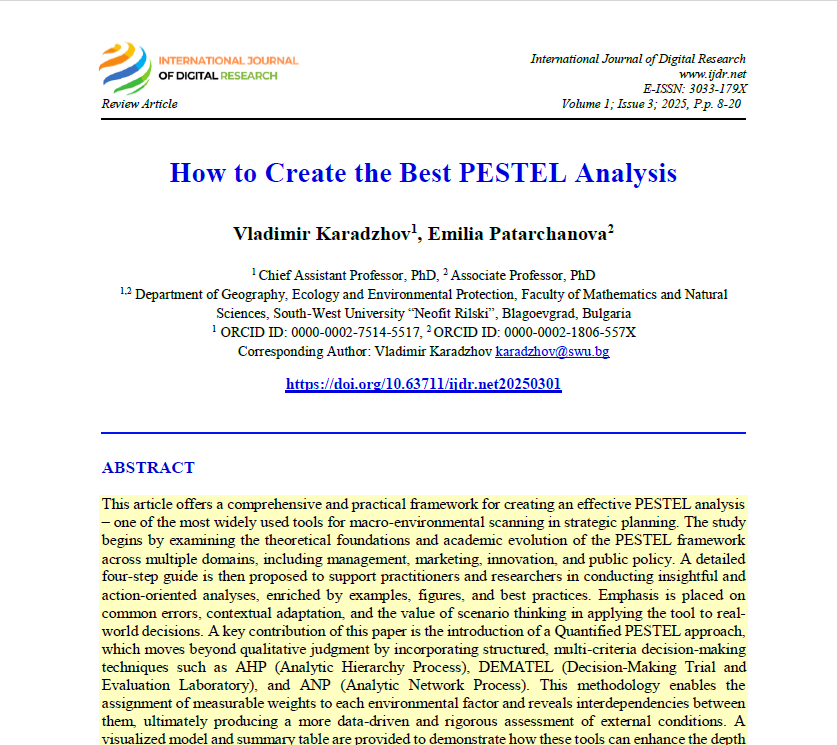
How to Create the Best PESTEL Analysis
Vladimir Karadzhov1, Emilia Patarchanova2 1 Chief Assistant Professor, PhD, 2 Associate Professor, PhD 1,2 Department of Geography, Ecology and Environmental Protection, Faculty of Mathematics and Natural Sciences, South-West University “Neofit Rilski”, Blagoevgrad, Bulgaria 1 ORCID ID: 0000-0002-7514-5517, 2 ORCID ID: 0000-0002-1806-557X Corresponding Author: Vladimir Karadzhov karadzhov@swu.bg Download https://doi.org/10.63711/ijdr.net20250301 ABSTRACT This article offers a comprehensive and practical framework for creating an effective PESTEL analysis – one of the most widely used tools for macro-environmental scanning in strategic planning. The study begins by examining the theoretical foundations and academic evolution of the PESTEL framework across multiple domains, including management, marketing, innovation, and public policy. A detailed four-step guide is then proposed to support practitioners and researchers in conducting insightful and action-oriented analyses, enriched by examples, figures, and best practices. Emphasis is placed on common errors, contextual adaptation, and the value of scenario thinking in applying the tool to real-world decisions. A key contribution of this paper is the introduction of a Quantified PESTEL approach, which moves beyond qualitative judgment by incorporating structured, multi-criteria decision-making techniques such as AHP (Analytic Hierarchy Process), DEMATEL (Decision-Making Trial and Evaluation Laboratory), and ANP (Analytic Network Process). This methodology enables the assignment of measurable weights to each environmental factor and reveals interdependencies between them, ultimately producing a more data-driven and rigorous assessment of external conditions. A visualized model and summary table are provided to demonstrate how these tools can enhance the depth and reliability of PESTEL outcomes. The article concludes with practical insights and a call for future research exploring dynamic, sector-specific, or AI-supported applications of the PESTEL methodology. Keywords: PESTEL Analysis, Strategic Planning, Quantified PESTEL, Multi-Criteria Decision-Making, AHP, DEMATEL, ANP, Environmental Scanning, Management Tools, Scenario Analysis Research Area: Economic Geography, Strategic Planning Copyright © 2025 The Author(s). This article is licensed under CC BY 4.0.
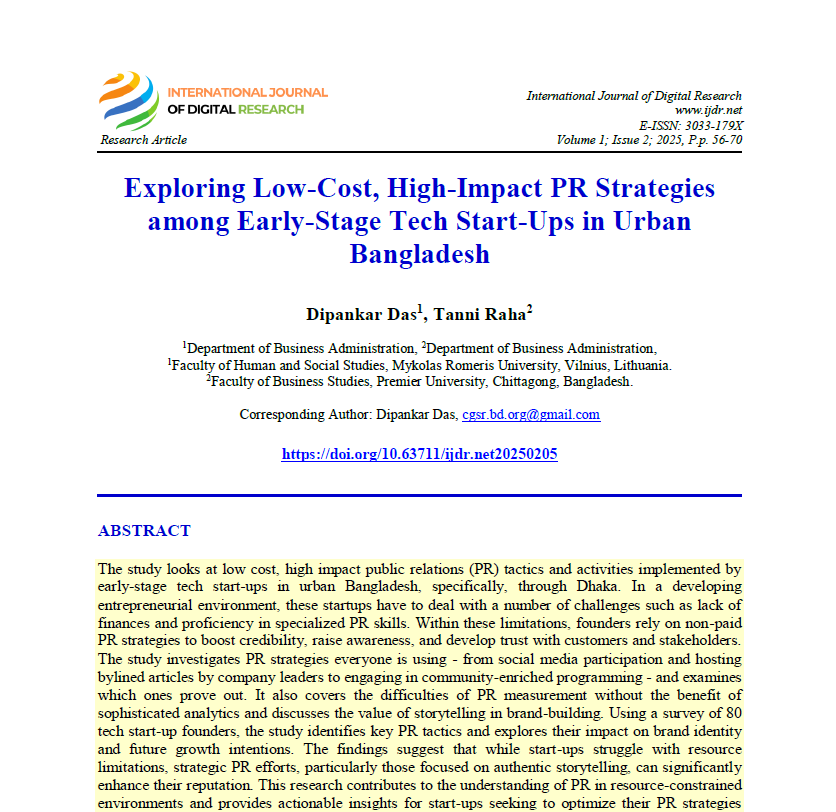
Exploring Low-Cost, High-Impact PR Strategies among Early-Stage Tech Start-Ups in Urban Bangladesh
Dipankar Das1, Tanni Raha2 1 Department of Business Administration, 2 Department of Business Administration, 1 Faculty of Human and Social Studies, Mykolas Romeris University, Vilnius, Lithuania. 2 Faculty of Business Studies, Premier University, Chittagong, Bangladesh. Corresponding Author: Dipankar Das cgsr.bd.org@gmail.com Download https://doi.org/10.63711/ijdr.net20250205 ABSTRACT The study looks at low cost, high impact public relations (PR) tactics and activities implemented by early-stage tech start-ups in urban Bangladesh, specifically, through Dhaka. In a developing entrepreneurial environment, these startups have to deal with a number of challenges such as lack of finances and proficiency in specialized PR skills. Within these limitations, founders rely on non-paid PR strategies to boost credibility, raise awareness, and develop trust with customers and stakeholders. The study investigates PR strategies everyone is using – from social media participation and hosting bylined articles by company leaders to engaging in community-enriched programming – and examines which ones prove out. It also covers the difficulties of PR measurement without the benefit of sophisticated analytics and discusses the value of storytelling in brand-building. Using a survey of 80 tech start-up founders, the study identifies key PR tactics and explores their impact on brand identity and future growth intentions. The findings suggest that while start-ups struggle with resource limitations, strategic PR efforts, particularly those focused on authentic storytelling, can significantly enhance their reputation. This research contributes to the understanding of PR in resource-constrained environments and provides actionable insights for start-ups seeking to optimize their PR strategies without substantial financial investment. Keywords: Public relations, Start-ups, Low-cost strategies, Bangladesh, Storytelling Research Area: Public Relations Copyright © 2025 The Author(s). This article is licensed under CC BY 4.0.
