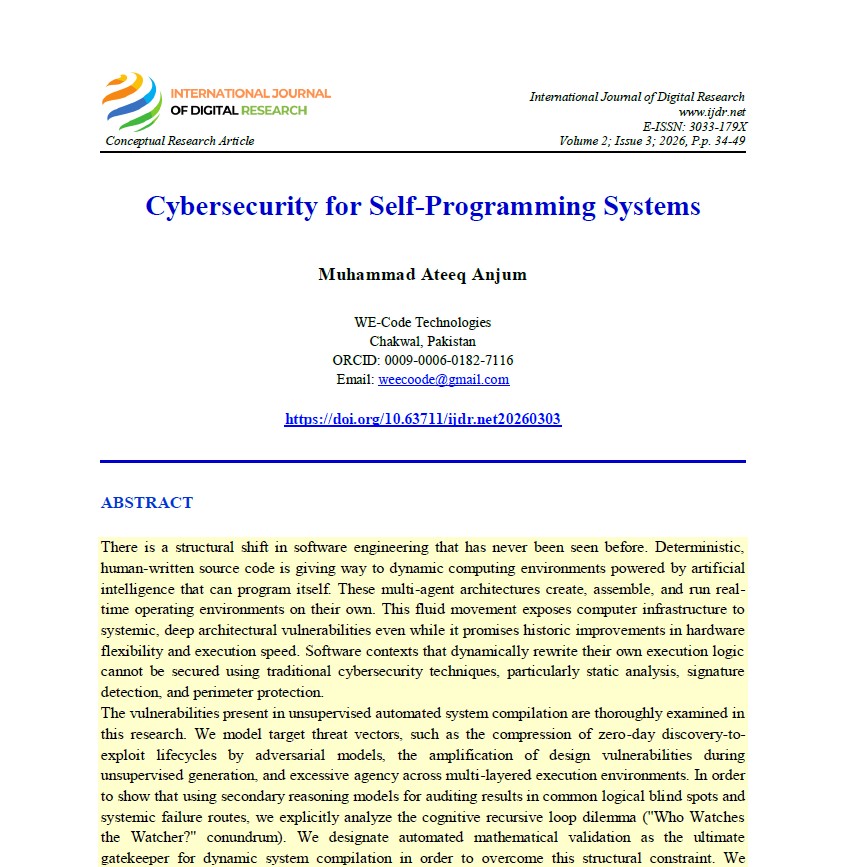
The International Journal of Digital Research (IJDR) is pleased to announce the publication of a new conceptual research article, “Cybersecurity for Self-Programming Systems,” by Muhammad Ateeq Anjum of WE-Code Technologies, Chakwal, Pakistan. The article appears in Volume 2, Issue 3 (2026) of IJDR, pp. 34–49.
As artificial intelligence moves beyond assisting programmers toward systems capable of generating, modifying, and executing their own code, traditional approaches to cybersecurity face a fundamentally different challenge. The new study examines the security risks associated with self-programming and agentic computing environments, where software may dynamically rewrite elements of its own execution logic.
The article explores emerging threat vectors including autonomous software generation, privilege escalation, prompt injection, rapidly shrinking vulnerability-to-exploitation windows, and the problem of relying on AI systems to verify code produced by other AI systems.
A central contribution of the study is the proposed Autonomous Defensive Layer (ADL) – a conceptual security architecture designed to protect future self-programming computing environments. The framework combines formal verification, micro-virtualization, continuous shadow reasoning, adversarial testing, and runtime validation to provide an independent security layer between autonomous code generation and execution.
The research also considers the broader governance and compliance implications of autonomous software systems and identifies important research gaps. As the author notes, the proposed ADL remains conceptual and requires future prototype implementation, performance evaluation, scalability testing, and empirical validation before it can be considered operationally mature.
Muhammad Ateeq Anjum – “Cybersecurity for Self-Programming Systems”
International Journal of Digital Research, 2(3), 34–49.
Article Page – IJDR
DOI: 10.63711/ijdr.net20260303
Permanent Archive – Zenodo