


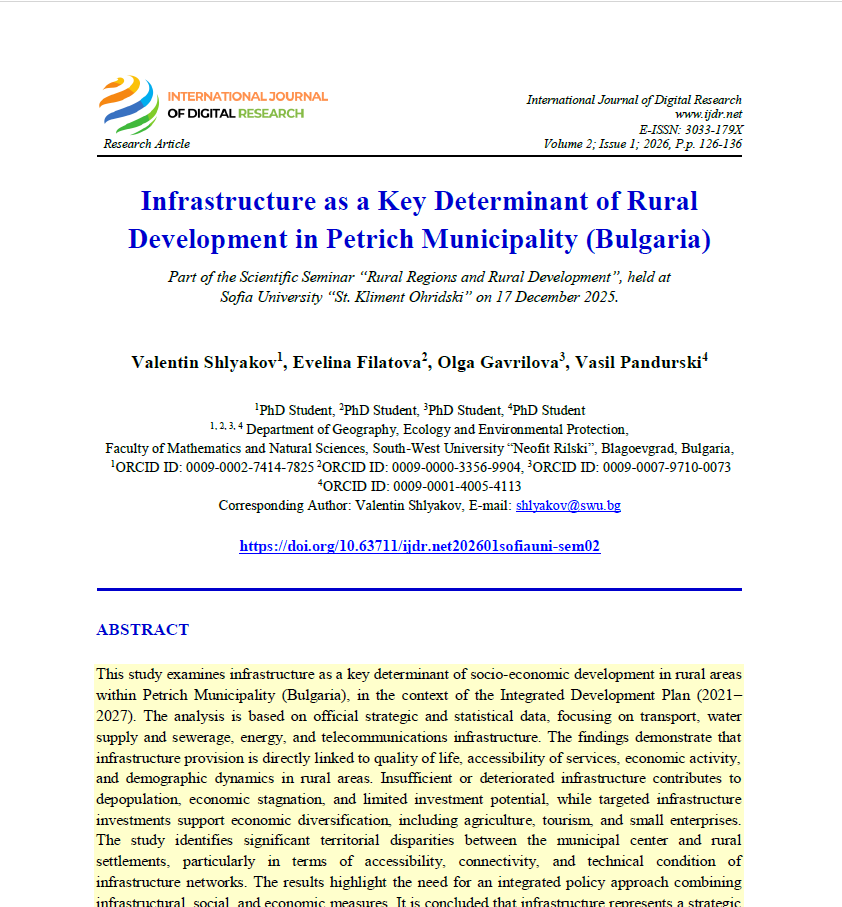
Part of the Scientific Seminar “Rural Regions and Rural Development”, held at Sofia University “St. Kliment Ohridski” on 17 December 2025. Valentin Shlyakov1, Evelina Filatova2, Olga Gavrilova3, Vasil Pandurski4 1PhD Student, 2PhD Student, 3PhD Student, 4PhD Student 1, 2, 3, 4 Department of Geography, Ecology and Environmental Protection, Faculty of Mathematics and Natural Sciences, South-West University “Neofit Rilski”, Blagoevgrad, Bulgaria, 1ORCID ID: 0009-0002-7414-78252ORCID ID: 0009-0000-3356-9904, 3ORCID ID: 0009-0007-9710-0073 4ORCID ID: 0009-0001-4005-4113 Corresponding Author: Valentin Shlyakov, E-mail: shlyakov@swu.bg Download https://doi.org/10.63711/ijdr.net202601sofiauni-sem02 ABSTRACT This study examines infrastructure as a key determinant of socio-economic development in rural areas within Petrich Municipality (Bulgaria), in the context of the Integrated Development Plan (2021–2027). The analysis is based on official strategic and statistical data, focusing on transport, water supply and sewerage, energy, and telecommunications infrastructure. The findings demonstrate that infrastructure provision is directly linked to quality of life, accessibility of services, economic activity, and demographic dynamics in rural areas. Insufficient or deteriorated infrastructure contributes to depopulation, economic stagnation, and limited investment potential, while targeted infrastructure investments support economic diversification, including agriculture, tourism, and small enterprises. The study identifies significant territorial disparities between the municipal center and rural settlements, particularly in terms of accessibility, connectivity, and technical condition of infrastructure networks. The results highlight the need for an integrated policy approach combining infrastructural, social, and economic measures. It is concluded that infrastructure represents a strategic instrument for achieving sustainable and balanced rural development and for enhancing the competitiveness of rural areas at both regional and national levels. Keywords: Rural infrastructure, Socio-economic development, Rural areas, Petrich Municipality, Territorial development Research Area: Regional Development, Economic Geography, Rural Studies Copyright ©2026 The Author(s). This article is licensed under CC BY 4.0.
New Article Published: Agri-Environmental Policy and Rural Development in Bulgaria
The International Journal of Digital Research (IJDR) is pleased to announce the publication of a new research article in Volume 2, Issue 1 (2026): 👉 “Agri-Environmental Policy and Rural Development in Bulgaria”by Ognyan Kitov and Emilia Patarchanova This study explores key aspects of agri-environmental policy within the framework of the CAP 2023–2027, focusing on sustainability, biodiversity conservation, eco-schemes, and rural development strategies in Bulgaria. The article provides a structured PESTEL-based analysis, offering valuable insights into the interaction between policy design, institutional capacity, and environmental objectives in rural regions. 📍 The publication is part of the Special Section:“Rural Regions and Rural Development”, featuring selected papers from the academic seminar held at Sofia University “St. Kliment Ohridski” on 17 December 2025. 🔗 Read the article:https://ijdr.net/volume-2-year-2026/volume-2-issue-1/agri-environmental-policy-rural-development-bulgaria/ 🔗 Explore the current issue:https://ijdr.net/current-issue/
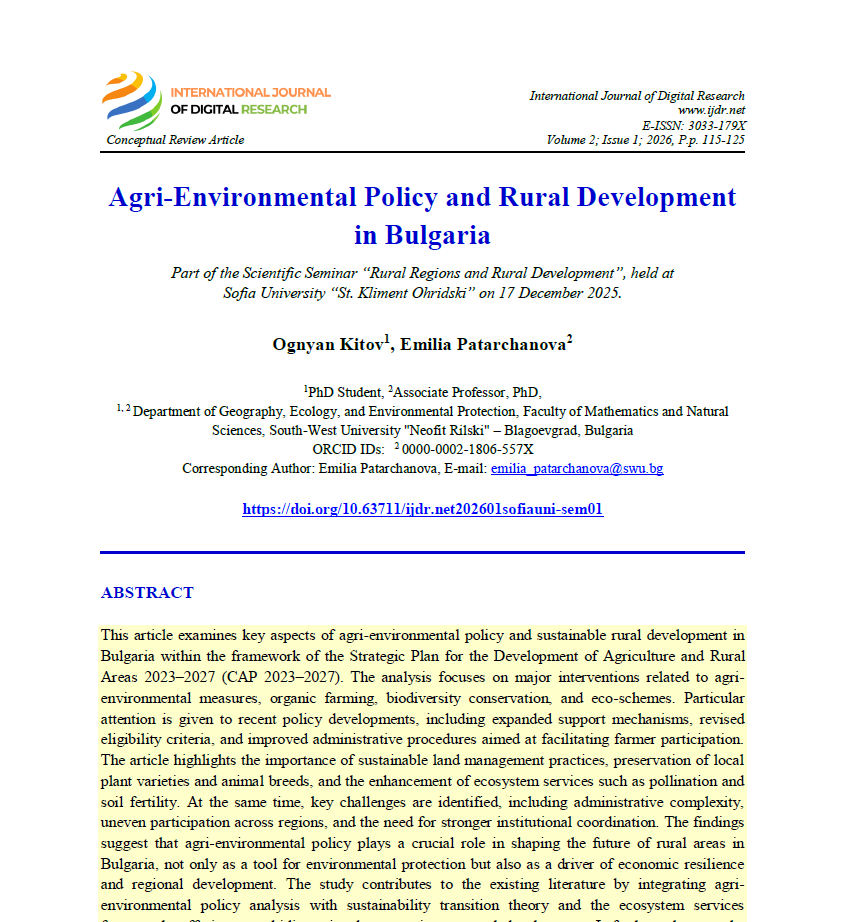
Agri-Environmental Policy and Rural Development in Bulgaria
Part of the Scientific Seminar “Rural Regions and Rural Development”, held at Sofia University “St. Kliment Ohridski” on 17 December 2025. Ognyan Kitov1, Emilia Patarchanova2 1PhD Student, 2Associate Professor, PhD, 1, 2 Department of Geography, Ecology, and Environmental Protection, Faculty of Mathematics and Natural Sciences, South-West University “Neofit Rilski” – Blagoevgrad, Bulgaria ORCID IDs: 1 0009-0001-7612-5200 2 0000-0002-1806-557X Corresponding Author: Emilia Patarchanova, E-mail: emilia_patarchanova@swu.bg Download https://doi.org/10.63711/ijdr.net202601sofiauni-sem01 ABSTRACT This article examines key aspects of agri-environmental policy and sustainable rural development in Bulgaria within the framework of the Strategic Plan for the Development of Agriculture and Rural Areas 2023–2027 (CAP 2023–2027). The analysis focuses on major interventions related to agri-environmental measures, organic farming, biodiversity conservation, and eco-schemes. Particular attention is given to recent policy developments, including expanded support mechanisms, revised eligibility criteria, and improved administrative procedures aimed at facilitating farmer participation. The article highlights the importance of sustainable land management practices, preservation of local plant varieties and animal breeds, and the enhancement of ecosystem services such as pollination and soil fertility. At the same time, key challenges are identified, including administrative complexity, uneven participation across regions, and the need for stronger institutional coordination. The findings suggest that agri-environmental policy plays a crucial role in shaping the future of rural areas in Bulgaria, not only as a tool for environmental protection but also as a driver of economic resilience and regional development. The study contributes to the existing literature by integrating agri-environmental policy analysis with sustainability transition theory and the ecosystem services framework, offering a multidimensional perspective on rural development. It further advances the understanding of CAP implementation in Eastern European contexts by highlighting the interaction between institutional capacity, environmental objectives, and technological transformation. Keywords: Agri-environmental policy; Rural development; Sustainability; Eco-schemes; Organic farming; Biodiversity; CAP 2023–2027; Bulgaria Research Area: Environmental Policy, Rural Development, Regional Studies Copyright © 2026 The Author(s). This article is licensed under CC BY 4.0.
New Article Published: Business and Ethics
A new IJDR article by Stoyan Kirov explores business ethics, CSR, ESG, and sustainability, proposing a framework for evaluating ethical corporate behavior.
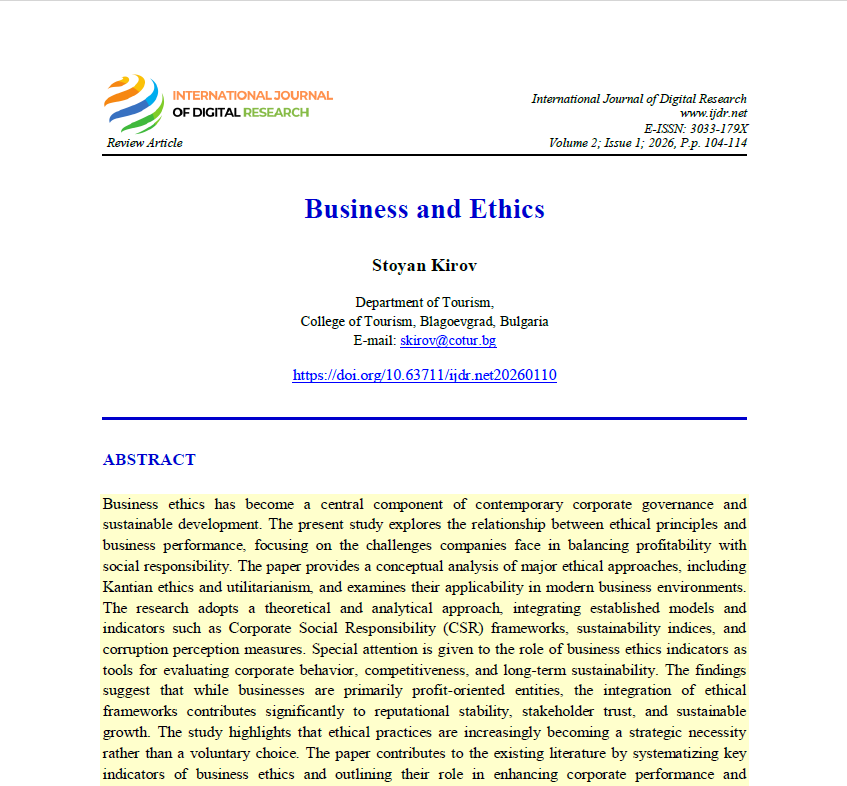
Business and Ethics
Stoyan Kirov Associate Professor, PhD, Department of Tourism, College of Tourism, Blagoevgrad, Bulgaria E-mail: skirov@cotur.bg Download https://doi.org/10.63711/ijdr.net20260110 ABSTRACT Business ethics has become a central component of contemporary corporate governance and sustainable development. The present study explores the relationship between ethical principles and business performance, focusing on the challenges companies face in balancing profitability with social responsibility. The paper provides a conceptual analysis of major ethical approaches, including Kantian ethics and utilitarianism, and examines their applicability in modern business environments. The research adopts a theoretical and analytical approach, integrating established models and indicators such as Corporate Social Responsibility (CSR) frameworks, sustainability indices, and corruption perception measures. Special attention is given to the role of business ethics indicators as tools for evaluating corporate behavior, competitiveness, and long-term sustainability. The findings suggest that while businesses are primarily profit-oriented entities, the integration of ethical frameworks contributes significantly to reputational stability, stakeholder trust, and sustainable growth. The study highlights that ethical practices are increasingly becoming a strategic necessity rather than a voluntary choice. The paper contributes to the existing literature by systematizing key indicators of business ethics and outlining their role in enhancing corporate performance and governance. Keywords: Business performance, Corporate social responsibility (CSR), ESG, Business ethics indicators, Ethical decision-making, Sustainability, Corruption perception index, Stakeholder theory Research Area: Business Ethics, Corporate Responsibility Copyright ©2026 The Author(s). This article is licensed under CC BY 4.0.
New Editorial Team Member Joins IJDR – Dr. Benjamin Naku
The International Journal of Digital Research (IJDR) is pleased to announce the appointment of a new member to its Editorial Team. Dr. Benjamin Naku, Head of the Department of Physical Education and Sports at the University of Shkodra “Luigj Gurakuqi”, Albania, has joined the journal as an Editorial Team Member. Dr. Naku brings extensive academic and professional experience in the field of Sports Science, Physical Education, and Health. His leadership role and long-standing academic career contribute valuable expertise to the journal’s multidisciplinary scope. His inclusion further strengthens IJDR’s international profile and supports the journal’s commitment to engaging scholars from diverse academic backgrounds and regions. We warmly welcome Dr. Naku to the IJDR Editorial Team and look forward to future collaboration.
IJDR Welcomes a New Editorial Team Member from Albania
The International Journal of Digital Research (IJDR) is pleased to welcome Assoc. Prof. Dr. Aida Shehu as a new member of its Editorial Team and Reviewer. Dr. Shehu is affiliated with the Sports University of Tirana, Albania, where she currently serves as Head of the Department of Collective Sports. She has an extensive academic and professional background in sports science, physical education, and health, with teaching and research experience spanning several decades. Her academic career includes positions at the University of Tirana and the Sports University of Tirana, where she has contributed to the development of higher education in sports sciences. Dr. Shehu has been actively involved in teaching subjects such as volleyball, basketball, football, and sports training methodology, as well as supervising academic programs at both bachelor’s and master’s levels. In addition to her teaching and leadership roles, she has participated in research projects focused on youth physical activity, health behavior, and sports education. Her recent scientific contributions include international conference publications addressing topics such as physical activity levels, motor development, and the impact of screen time on children. With her strong academic profile and leadership experience, Dr. Shehu will contribute to strengthening IJDR’s interdisciplinary scope, particularly in the fields of sports science, education, and health. We warmly welcome her to the IJDR community and look forward to her valuable contributions.
New Article Published: From Newtonian Economics to Quantum Uncertainty
The International Journal of Digital Research (IJDR) is pleased to announce the publication of a new review article exploring the transformation of economic thinking in the era of technological change and radical uncertainty. The article “From Newtonian Economics to Quantum Uncertainty: The Revolution Reshaping Economic Theory”, authored by Ioannis Aznaouridis (University of Derby, Mediterranean College, Athens) and Chris-Nektarios Aznaouridis (University of Patras), examines the shift from deterministic economic models toward a new conceptual framework shaped by uncertainty, complexity, and emerging quantum technologies. The study analyzes how the traditional Newtonian paradigm of predictability and equilibrium is increasingly challenged by the dynamics of modern economic systems, where information asymmetry, technological disruption, and nonlinear interactions reshape theoretical assumptions. Drawing on insights from quantum physics, philosophy of science, and contemporary economic thought, the authors propose a new epistemological perspective that integrates radical uncertainty, participatory knowledge, and evolving informational structures. The article contributes to the growing interdisciplinary dialogue between economics, technology, and philosophy of science, highlighting how quantum information and computational advances may influence future economic modeling and decision-making. 📄 Read the article:https://doi.org/10.63711/ijdr.net20260106 The article is published in International Journal of Digital Research, Volume 2, Issue 1 (2026).
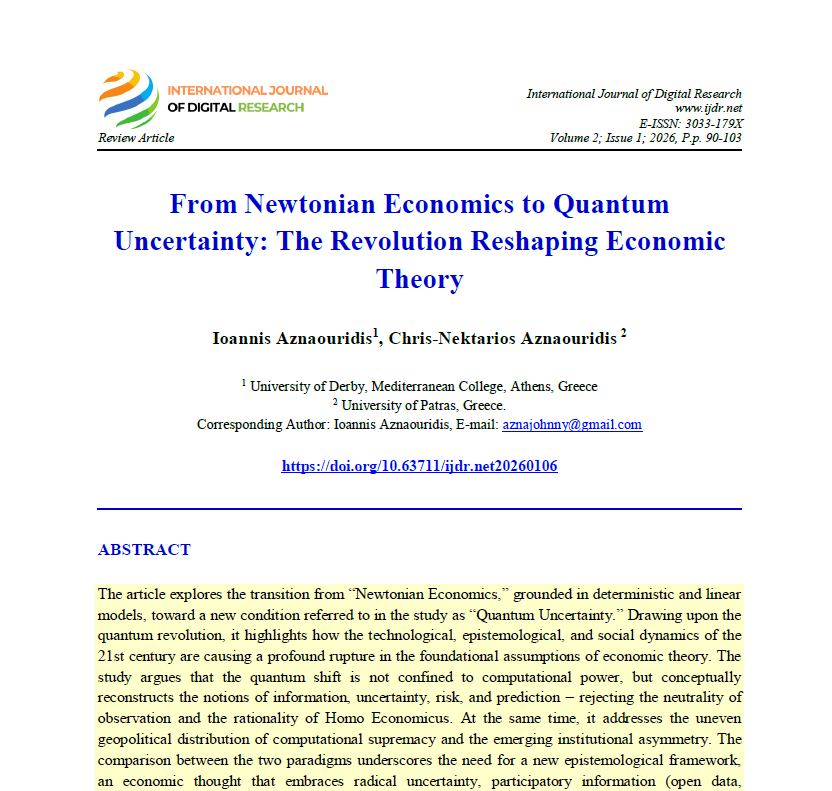
From Newtonian Economics to Quantum Uncertainty: The Revolution Reshaping Economic Theory
Ioannis Aznaouridis1, Chris-Nektarios Aznaouridis 2 1 University of Derby, Mediterranean College, Athens, Greece 2 University of Patras, Greece. Corresponding Author: Ioannis Aznaouridis, E-mail: aznajohnny@gmail.com Download https://doi.org/10.63711/ijdr.net20260106 ABSTRACT The article explores the transition from “Newtonian Economics,” grounded in deterministic and linear models, toward a new condition referred to in the study as “Quantum Uncertainty.” Drawing upon the quantum revolution, it highlights how the technological, epistemological, and social dynamics of the 21st century are causing a profound rupture in the foundational assumptions of economic theory. The study argues that the quantum shift is not confined to computational power, but conceptually reconstructs the notions of information, uncertainty, risk, and prediction – rejecting the neutrality of observation and the rationality of Homo Economicus. At the same time, it addresses the uneven geopolitical distribution of computational supremacy and the emerging institutional asymmetry. The comparison between the two paradigms underscores the need for a new epistemological framework, an economic thought that embraces radical uncertainty, participatory information (open data, collective intelligence), and open, nonlinear models of economic reality. Keywords: Predictability, Collective Intelligence, Quantum Uncertainty, Technological supremacy, Rationality, Epistemic Modelling Research Area: Economics, Economic Theory, Philosophy of Economics Copyright ©2026 The Author(s). This article is licensed under CC BY 4.0.
IJDR Welcomes Four New Editorial Board Members
The International Journal of Digital Research (IJDR) is pleased to announce the expansion of its Editorial Board with the appointment of four distinguished scholars. We warmly welcome: Their expertise strengthens IJDR’s interdisciplinary scope in digital transformation, education, management, tourism and sustainability studies. With these appointments, IJDR continues to develop a structured and internationally engaged editorial team, reinforcing its commitment to high academic standards, rigorous peer review and thematic diversity. We are proud to welcome our new colleagues and look forward to their valuable contribution to the journal’s continued growth.
