


IJDR announces a new study introducing a structured SOAR Validation and Measurability Model for evidence-based strategic planning.
How to Create the Best SOAR Analysis
This article introduces a structured SOAR Validation and Measurability Model, embedding KPIs and strategic alignment into strength-based planning frameworks.
International Journal of Digital Research Reaches 30 Published Articles
International Journal of Digital Research marks a major milestone with 30 published articles, growing citations, and strong interdisciplinary impact.
High-Resolution Burn Severity Mapping in Mixed Coniferous and Deciduous Forests: The Case of the 2025 Ilindentsi Wildfire
This study analyzes the ecological impact and burn severity of the 2025 Ilindentsi wildfire in Southwestern Bulgaria using high-resolution Sentinel-2 imagery and Google Earth Engine. The results support targeted post-fire restoration and sustainable forest management.
Ecosystem Approach in Digital Tourism and Hospitality
This article analyses the ecosystem approach in digital tourism and hospitality, highlighting the coordinating role of hospitality enterprises and digital platforms. It discusses ecosystem coordination, sustainability, and platform dependency risks in modern tourism development.
Youth Participation and Epistemic Authority in Digital Mental Health Design and Governance
Vladislava Lendzhova Department of Sociology, South-West University “Neofit Rilski”, Blagoevgrad, Bulgaria ORCID: 0000-0001-9757-3419 Corresponding Author: Vladislava Lendzhova, E-mail: vlendzhova@swu.bg Download https://doi.org/10.63711/ijdr.net20260102 ABSTRACT Digital mental health technologies targeting young people have expanded rapidly amid growing concern about youth mental distress and the normalization of digital care. Yet despite being the primary users of such systems, young people have limited influence over how digital mental health is conceptualised, designed and governed. The paper examines digital youth mental health as a sociotechnical field and situates debates on youth agency, expertise and digital governance within contemporary concerns about participation and legitimacy. Drawing on a qualitative documentary analysis of policy frameworks, academic and professional literature, and youth advocacy and civil society materials (n = 86), the study investigates how authority, legitimacy and participation are attributed and contested across institutional domains. The analysis identifies three dominant framings of participation normative rhetoric, managed consultation and emerging epistemic authority and demonstrates how youth involvement is simultaneously invoked, constrained and instrumentalised. These dynamics reflect deeper tensions between safeguarding and autonomy, user engagement and democratic governance, and clinical expertise and lived experience. The paper argues that meaningful participation requires recognising young people as knowledge-holders and redistributing decision-making power within digital mental health design and governance processes. In doing so, the study contributes to sociological understandings of youth agency, digital governance and the politics of mental health care and highlights the need for participatory infrastructures capable of supporting youth co-governance in digital mental health. Keywords: Digital mental health, Youth engagement, Youth co-design, Datafication, Mental health interventions Research Area: Digital Sociology, Sociology of Youth Copyright © 2026 The Author(s). This article is licensed under CC BY 4.0.
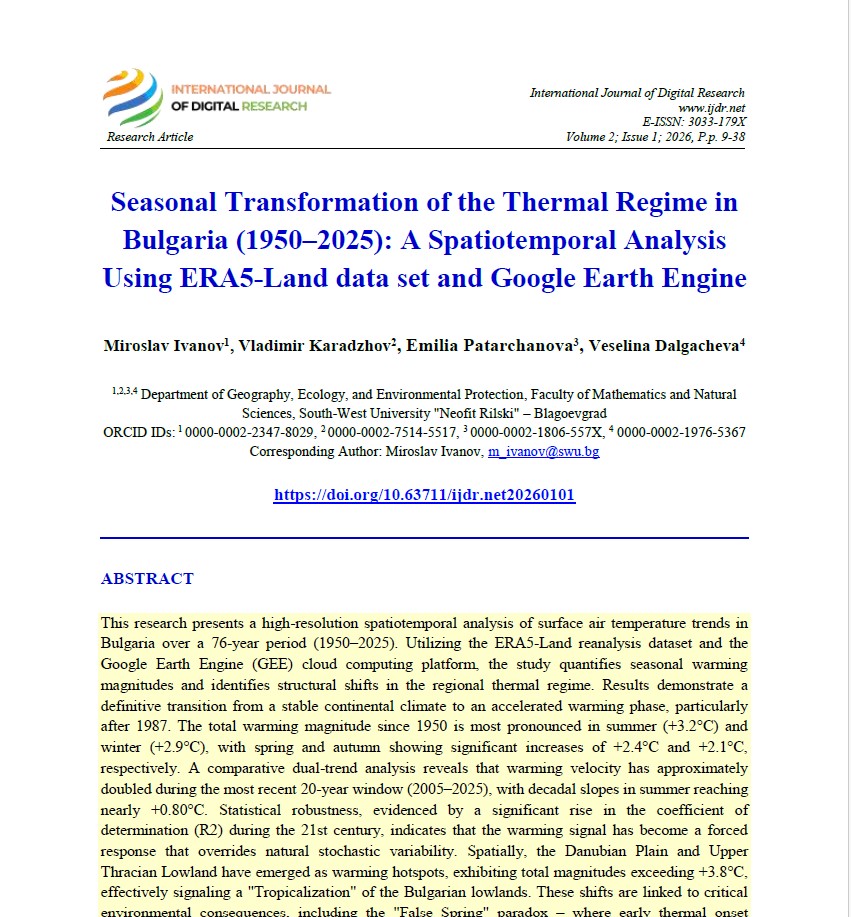
Seasonal Transformation of the Thermal Regime in Bulgaria (1950–2025): A Spatiotemporal Analysis Using ERA5-Land data set and Google Earth Engine
This research article analyses seasonal and long-term temperature changes in Bulgaria (1950–2025) using ERA5-Land data and Google Earth Engine, revealing clear spatiotemporal warming patterns.
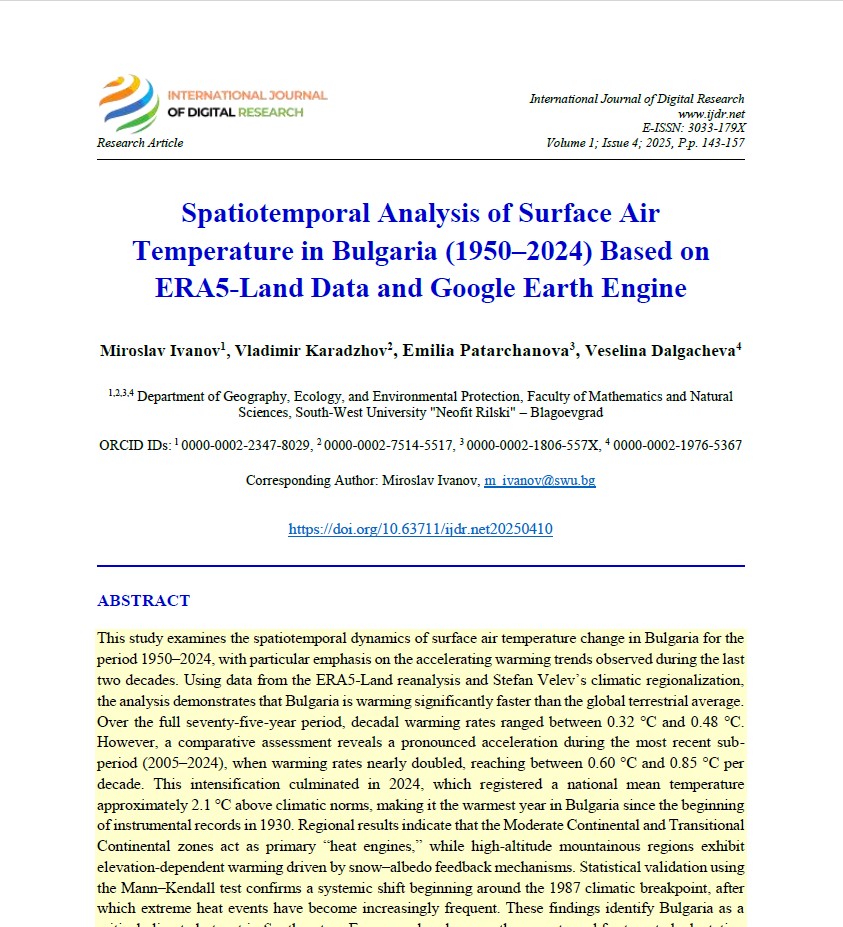
Spatiotemporal Analysis of Surface Air Temperature in Bulgaria (1950–2024) Based on ERA5-Land Data and Google Earth Engine
Miroslav Ivanov1, Vladimir Karadzhov2, Emilia Patarchanova3, Veselina Dalgacheva4 1,2,3,4 Department of Geography, Ecology, and Environmental Protection, Faculty of Mathematics and Natural Sciences, South-West University “Neofit Rilski” – Blagoevgrad ORCID IDs: 1 0000-0002-2347-8029, 2 0000-0002-7514-5517, 3 0000-0002-1806-557X, 4 0000-0002-1976-5367 Corresponding Author: Miroslav Ivanov, m_ivanov@swu.bg Download https://doi.org/10.63711/ijdr.net20250410 ABSTRACT This study examines the spatiotemporal dynamics of surface air temperature change in Bulgaria for the period 1950–2024, with particular emphasis on the accelerating warming trends observed during the last two decades. Using data from the ERA5-Land reanalysis and Stefan Velev’s climatic regionalization, the analysis demonstrates that Bulgaria is warming significantly faster than the global terrestrial average. Over the full seventy-five-year period, decadal warming rates ranged between 0.32 °C and 0.48 °C. However, a comparative assessment reveals a pronounced acceleration during the most recent sub-period (2005–2024), when warming rates nearly doubled, reaching between 0.60 °C and 0.85 °C per decade. This intensification culminated in 2024, which registered a national mean temperature approximately 2.1 °C above climatic norms, making it the warmest year in Bulgaria since the beginning of instrumental records in 1930. Regional results indicate that the Moderate Continental and Transitional Continental zones act as primary “heat engines,” while high-altitude mountainous regions exhibit elevation-dependent warming driven by snow–albedo feedback mechanisms. Statistical validation using the Mann–Kendall test confirms a systemic shift beginning around the 1987 climatic breakpoint, after which extreme heat events have become increasingly frequent. These findings identify Bulgaria as a critical climate hotspot in Southeastern Europe and underscore the urgent need for targeted adaptation strategies in agriculture, water resource management, and urban planning. Keywords: Climate acceleration, Bulgaria, Surface air temperature, ERA5-Land, Remote sensing Research Area: Climate Change, Remote Sensing, Environmental Analysis Copyright © 2025 The Author(s). This article is licensed under CC BY 4.0.
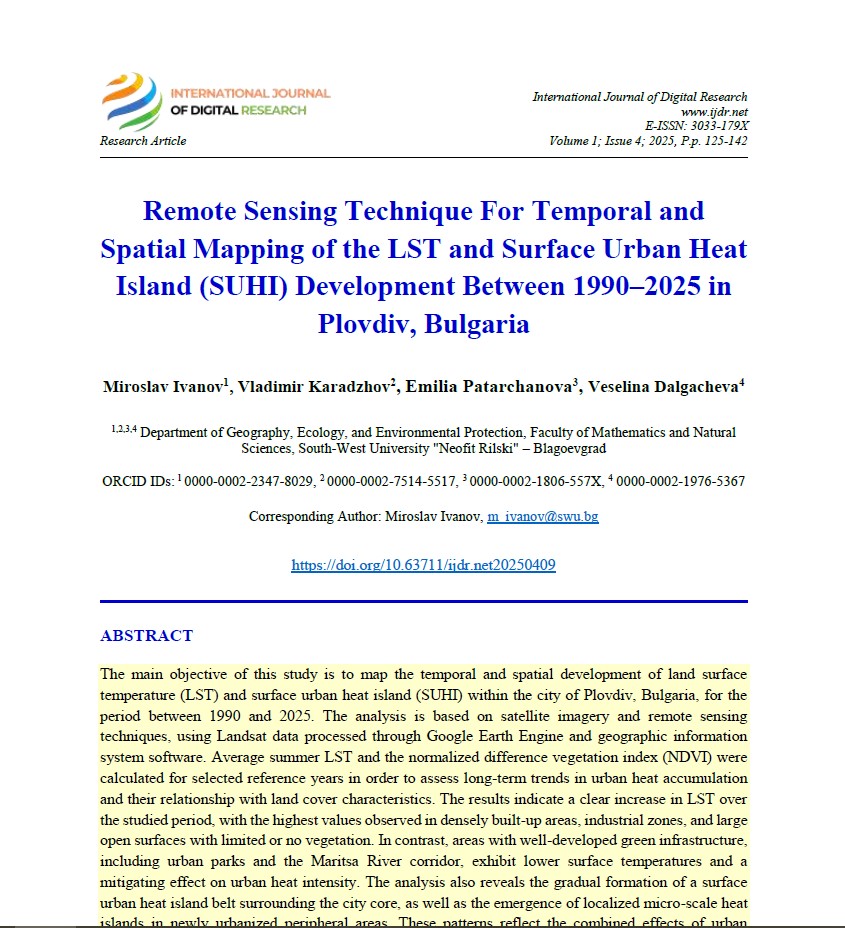
Remote Sensing Technique For Temporal and Spatial Mapping of the LST and Surface Urban Heat Island (SUHI) Development Between 1990–2025 in Plovdiv, Bulgaria
Miroslav Ivanov1, Vladimir Karadzhov2, Emilia Patarchanova3, Veselina Dalgacheva4 1,2,3,4 Department of Geography, Ecology, and Environmental Protection, Faculty of Mathematics and Natural Sciences, South-West University “Neofit Rilski” – Blagoevgrad ORCID IDs: 1 0000-0002-2347-8029, 2 0000-0002-7514-5517, 3 0000-0002-1806-557X, 4 0000-0002-1976-5367 Corresponding Author: Miroslav Ivanov, m_ivanov@swu.bg Download https://doi.org/10.63711/ijdr.net20250409 ABSTRACT The main objective of this study is to map the temporal and spatial development of land surface temperature (LST) and surface urban heat island (SUHI) within the city of Plovdiv, Bulgaria, for the period between 1990 and 2025. The analysis is based on satellite imagery and remote sensing techniques, using Landsat data processed through Google Earth Engine and geographic information system software. Average summer LST and the normalized difference vegetation index (NDVI) were calculated for selected reference years in order to assess long-term trends in urban heat accumulation and their relationship with land cover characteristics. The results indicate a clear increase in LST over the studied period, with the highest values observed in densely built-up areas, industrial zones, and large open surfaces with limited or no vegetation. In contrast, areas with well-developed green infrastructure, including urban parks and the Maritsa River corridor, exhibit lower surface temperatures and a mitigating effect on urban heat intensity. The analysis also reveals the gradual formation of a surface urban heat island belt surrounding the city core, as well as the emergence of localized micro-scale heat islands in newly urbanized peripheral areas. These patterns reflect the combined effects of urban expansion, land-use change, and regional climate warming. The study confirms the reliability of satellite-based remote sensing for assessing urban thermal environments and highlights its practical relevance for sustainable urban planning, climate adaptation measures, and smart city development. Keywords: Remote sensing, Land surface temperature, Surface urban heat island, NDVI, LST, Landsat satellites, Urban climate, Plovdiv, Bulgaria Research Area: Remote Sensing, Urban Climate, Sustainable Cities Copyright © 2025 The Author(s). This article is licensed under CC BY 4.0.
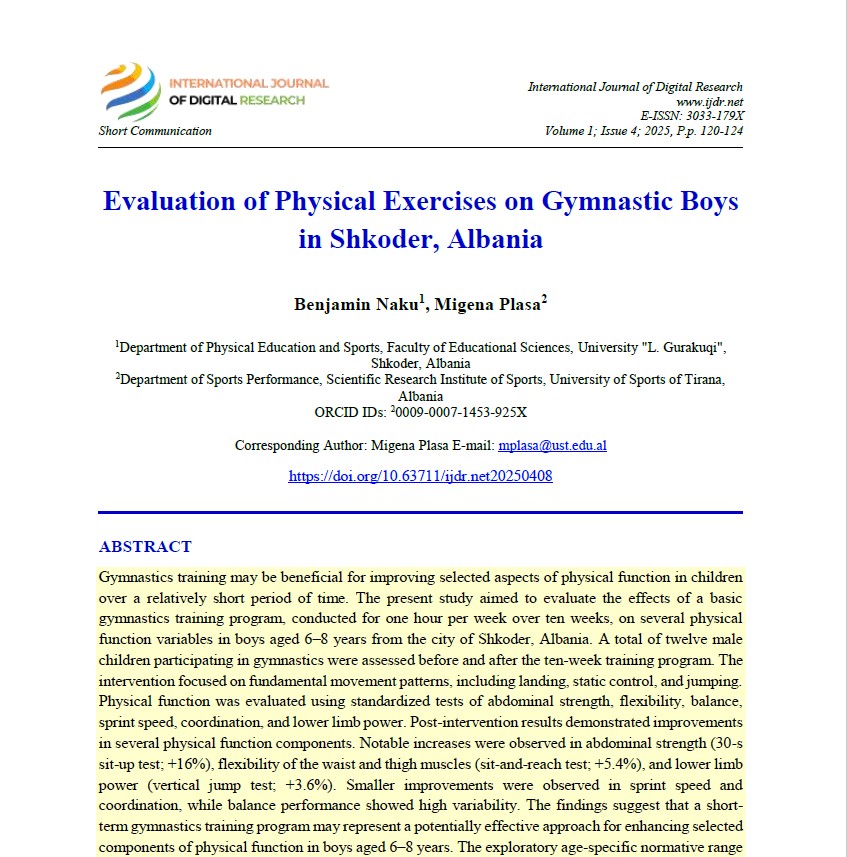
Evaluation of Physical Exercises on Gymnastic Boys in Shkoder, Albania
Benjamin Naku1, Migena Plasa2 1Department of Physical Education and Sports, Faculty of Educational Sciences, University “L. Gurakuqi”, Shkoder, Albania 2Department of Sports Performance, Scientific Research Institute of Sports, University of Sports of Tirana, Albania ORCID IDs: 10009-0003-8243-8494 20009-0007-1453-925X Corresponding Author: Migena Plasa E-mail: mplasa@ust.edu.al Download https://doi.org/10.63711/ijdr.net20250408 ABSTRACT Gymnastics training may be beneficial for improving selected aspects of physical function in children over a relatively short period of time. The present study aimed to evaluate the effects of a basic gymnastics training program, conducted for one hour per week over ten weeks, on several physical function variables in boys aged 6–8 years from the city of Shkoder, Albania. A total of twelve male children participating in gymnastics were assessed before and after the ten-week training program. The intervention focused on fundamental movement patterns, including landing, static control, and jumping. Physical function was evaluated using standardized tests of abdominal strength, flexibility, balance, sprint speed, coordination, and lower limb power. Post-intervention results demonstrated improvements in several physical function components. Notable increases were observed in abdominal strength (30-s sit-up test; +16%), flexibility of the waist and thigh muscles (sit-and-reach test; +5.4%), and lower limb power (vertical jump test; +3.6%). Smaller improvements were observed in sprint speed and coordination, while balance performance showed high variability. The findings suggest that a short-term gymnastics training program may represent a potentially effective approach for enhancing selected components of physical function in boys aged 6–8 years. The exploratory age-specific normative range tables derived from baseline testing may be useful to practitioners conducting similar physical function assessments in young children. Keywords: Gymnastics, Physical fitness, Motor development, Children aged 6–8 years, Physical education. Research Area: Sports Science, Child Motor Development, Physical Education Copyright © 2025 The Author(s). This article is licensed under CC BY 4.0.
