


This article has been removed from the journal website following a joint request and written agreement of authors. The removal was carried out in accordance with COPE guidelines. The content is no longer part of the active scientific record.
International Journal of Digital Research in 2025 – A Year in Review
Founded on 17 March 2025, the International Journal of Digital Research (IJDR) was created to support high-quality, open-access scholarship in digital and interdisciplinary research. In less than one calendar year, IJDR established solid publishing output, international visibility, and the core infrastructure needed for long-term academic credibility. Publishing results In 2025, IJDR published: These outcomes reflect IJDR’s commitment to quality-focused growth supported by clear editorial standards and peer review. Global readership and reach Google Analytics data for the 2025 calendar year shows: The largest audiences came from the United States and Bulgaria, followed by strong traffic from countries such as Ireland, the Netherlands, China, India, Germany, Bangladesh, Canada, and the United Kingdom. Across regions, engagement patterns indicate that readers are not only discovering IJDR, but actively spending time with its content. Indexing, repositories, and permanence A key priority in 2025 was ensuring visibility and long-term access. IJDR is now: This strengthens discoverability, trust, and the long-term availability of published research. DOI infrastructure and publishing standards In 2025, IJDR became a Crossref member and began issuing its own DOIs, ensuring persistent identifiers, standardized metadata dissemination, and improved citation traceability for all published articles. An international editorial team By the end of 2025, IJDR had built an international editorial community of 30 scholars and researchers. The journal maintains a clear structure (Editorial Board and Editorial Team), supporting both academic oversight and efficient editorial operations: https://ijdr.net/editorial-team/ Looking ahead The year 2025 laid a strong foundation. In 2026, IJDR will continue to focus on editorial quality, international collaboration, scholarly visibility, and ethical open-access publishing.To every author, reviewer, editor, and reader – thank you for helping build IJDR’s first year of success.
IJDR Welcomes a New Editor
The International Journal of Digital Research (IJDR) is pleased to welcome Dr. Filipe José Alves do Couto to the journal’s editorial team. Dr. Couto holds a PhD in Education Sciences from the Portuguese Catholic University and is an Adjunct Professor at the European Institute of Higher Education (Malta). He is also a researcher at the Centre for Human Development Research (CEDH) at the Portuguese Catholic University. His academic work focuses on social pedagogy, educational technologies, community development, and territorial development, with extensive experience in higher education, research projects, and international academic cooperation. Dr. Couto has an impressive international academic profile, including teaching and research activities in Europe, Africa, and Southeast Asia, as well as active involvement in peer review, scientific committees, and international research projects. His interdisciplinary expertise and strong engagement with education, digital transformation, and social development align closely with IJDR’s mission to promote high-quality, impactful, and globally relevant digital research. We are confident that Dr. Filipe José Alves do Couto’s experience and scholarly perspective will make a valuable contribution to the continued development and international visibility of the International Journal of Digital Research. Welcome to the IJDR editorial team!
International Journal of Digital Research now Indexed in Dimensions
We are pleased to announce that the International Journal of Digital Research (IJDR) has been abstracted and indexed in Dimensions – a globally recognized research database that enhances the discoverability and visibility of scholarly publications worldwide. Dimensions is widely used by researchers, institutions, and policymakers to explore high-quality academic content, citation data, and research impact across disciplines. Inclusion in this database represents an important milestone for IJDR and further confirms the journal’s commitment to academic quality, transparency, and international visibility. This new indexing strengthens IJDR’s position as an emerging multidisciplinary journal in the field of digital research and supports our mission to disseminate open-access research to a global academic audience. We thank our authors, reviewers, and editorial board members for their continuous support and contribution to the journal’s development.
New Article Published: Policies for the Development of Border Regions
The International Journal of Digital Research (IJDR) is pleased to announce the publication of a new article by Vasil Pandurski, titled “Policies at the European, National and Regional Levels Aimed at the Development of Border Regions.” The study offers a comprehensive analysis of multilevel governance frameworks shaping the development of border municipalities, highlighting the interplay between European cohesion policy, national regulations, and regional strategic planning. The article provides valuable insights into administrative capacity, territorial cohesion, and the challenges facing border regions in Bulgaria and across the EU. Read the full article:https://ijdr.net/policies-border-region-development DOI: https://doi.org/10.63711/ijdr.net20250406 Permanent archive:Zenodo – https://zenodo.org/records/17856636 IJDR congratulates the author and encourages researchers, practitioners, and policymakers to engage with this important contribution to regional development studies.
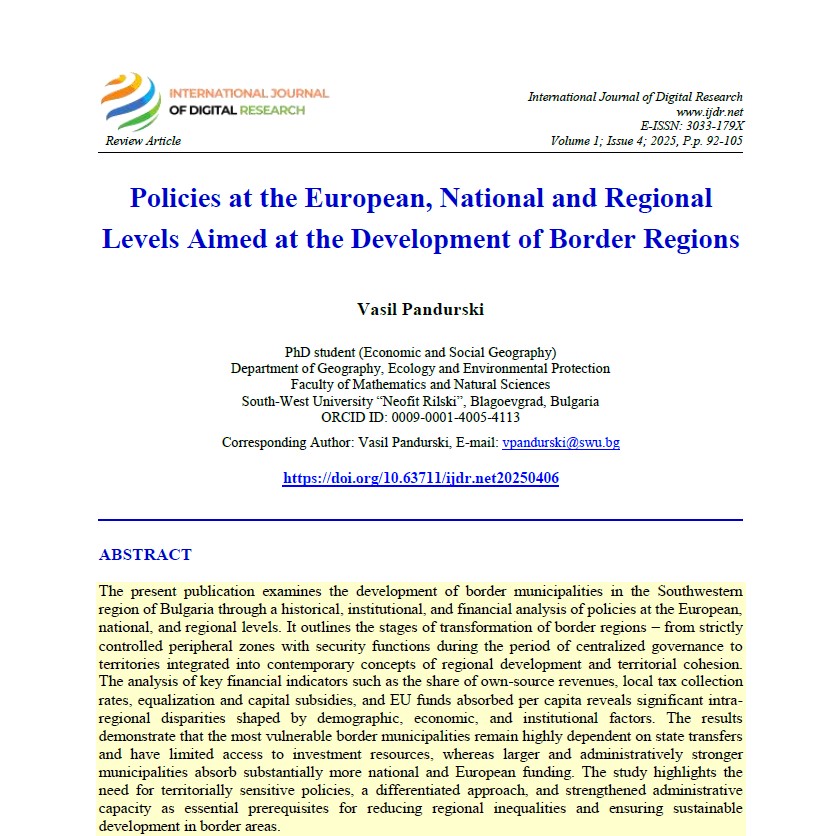
Policies at the European, National and Regional Levels Aimed at the Development of Border Regions
Vasil Pandurski PhD student (Economic and Social Geography) Department of Geography, Ecology and Environmental Protection Faculty of Mathematics and Natural Sciences South-West University “Neofit Rilski”, Blagoevgrad, Bulgaria ORCID ID: 0009-0001-4005-4113 Corresponding Author: Vasil Pandurski, E-mail: vpandurski@swu.bg Download https://doi.org/10.63711/ijdr.net20250406 ABSTRACT The present publication examines the development of border municipalities in the Southwestern region of Bulgaria through a historical, institutional, and financial analysis of policies at the European, national, and regional levels. It outlines the stages of transformation of border regions – from strictly controlled peripheral zones with security functions during the period of centralized governance to territories integrated into contemporary concepts of regional development and territorial cohesion. The analysis of key financial indicators such as the share of own-source revenues, local tax collection rates, equalization and capital subsidies, and EU funds absorbed per capita reveals significant intra-regional disparities shaped by demographic, economic, and institutional factors. The results demonstrate that the most vulnerable border municipalities remain highly dependent on state transfers and have limited access to investment resources, whereas larger and administratively stronger municipalities absorb substantially more national and European funding. The study highlights the need for territorially sensitive policies, a differentiated approach, and strengthened administrative capacity as essential prerequisites for reducing regional inequalities and ensuring sustainable development in border areas. Keywords: Border regions, Regional policy, Territorial cohesion, Fiscal decentralization, Cross-border cooperation Research Area: Regional Development, Regional Policy Copyright © 2025 The Author(s). This article is licensed under CC BY 4.0.
IJDR Now Indexed in Semantic Scholar – Expanding Global Scholarly Visibility
The International Journal of Digital Research (IJDR) is proud to announce that our journal is now indexed in Semantic Scholar, one of the world’s leading AI-powered academic discovery platforms. Semantic Scholar, developed by the Allen Institute for Artificial Intelligence (AI2), is used by millions of researchers to access high-quality scientific literature. Its advanced AI-driven algorithms extract citations, analyze impact, and connect research outputs across disciplines.With this inclusion, IJDR articles are now easier to discover, cite, and integrate into global scientific workflows. View IJDR in Semantic Scholar:https://www.semanticscholar.org/search?q=%22International%20Journal%20of%20Digital%20Research%22&sort=relevance What This Means for IJDR AuthorsBeing indexed in Semantic Scholar provides several important benefits: A Milestone in IJDR’s Indexing Expansion This achievement adds to IJDR’s continually growing indexing portfolio, which already includes:CrossRef, Google Scholar, ORCID, OpenAIRE, Zenodo, Dimensions, Scilit, R Discovery, OpenAlex, Harvard Library, BASE, Princeton Library, Leiden University Libraries, COBISS+, ISSN Portal, ROAD and more. Our strategic commitment remains unchanged:to maintain full open access, ensure high-quality research dissemination, and support global academic collaboration. We extend our gratitude to all authors, reviewers, editors, and partners who help strengthen IJDR’s international presence.
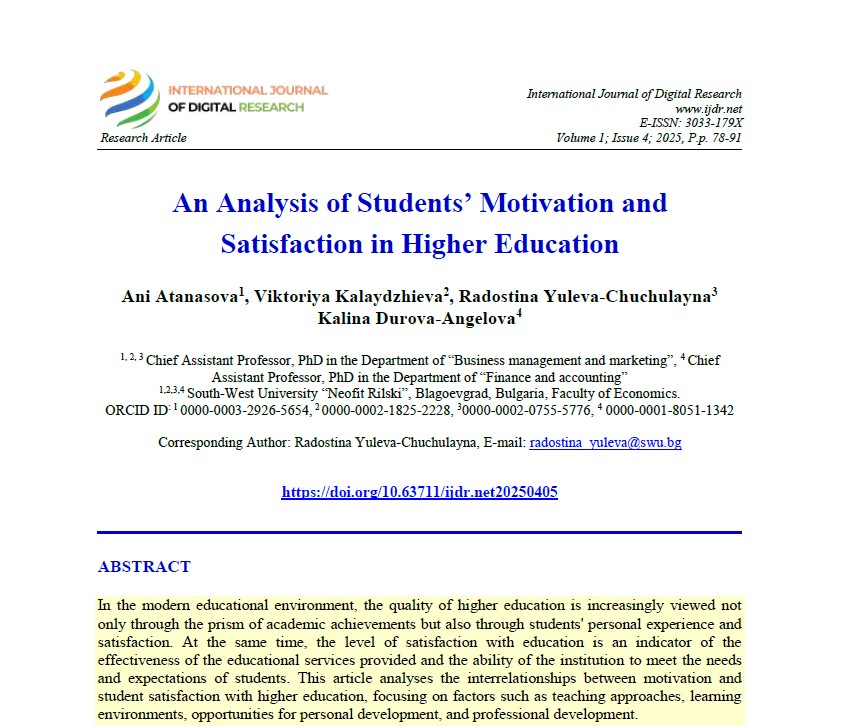
An Analysis of Students’ Motivation and Satisfaction in Higher Education
Ani Atanasova1, Viktoriya Kalaydzhieva2, Radostina Yuleva-Chuchulayna3 Kalina Durova-Angelova4 1, 2, 3 Chief Assistant Professor, PhDin the Department of “Business management and marketing”, 4 Chief Assistant Professor, PhD in the Department of “Finance and accounting” 1,2,3,4 South-West University “Neofit Rilski”, Blagoevgrad, Bulgaria, Faculty of Economics. ORCID ID: 1 0000-0003-2926-5654, 2 0000-0002-1825-2228, 30000-0002-0755-5776, 4 0000-0001-8051-1342 Corresponding Author: Radostina Yuleva-Chuchulayna, E-mail: radostina_yuleva@swu.bg Download https://doi.org/10.63711/ijdr.net20250405 ABSTRACT In the modern educational environment, the quality of higher education is increasingly viewed not only through the prism of academic achievements but also through students’ personal experience and satisfaction. At the same time, the level of satisfaction with education is an indicator of the effectiveness of the educational services provided and the ability of the institution to meet the needs and expectations of students. This article analyses the interrelationships between motivation and student satisfaction with higher education, focusing on factors such as teaching approaches, learning environments, opportunities for personal development, and professional development. Keywords: Higher education, Students, Motive, Satisfaction, Motivation Research Area: Higher Education Studies, Student Motivation, Learning Psychology Copyright © 2025 The Author(s). This article is licensed under CC BY 4.0.
New Article Published: Labor Market in Southwestern Bulgaria’s Border Municipalities
The International Journal of Digital Research is pleased to announce the publication of a significant new study titled “Labor Market in the Border Municipalities of Southwestern Bulgaria – Challenges and Trends,” authored by Vasil Pandurski (South-West University “Neofit Rilski”). The article delivers one of the most comprehensive territorial analyses of recent years, exploring the complex socio-economic dynamics in fourteen border municipalities. It examines critical labour-market indicators such as employment, unemployment, long-term joblessness, wage disparities, and daily labour mobility patterns. A key contribution of the study is its detailed spatial interpretation, revealing how geography, transport accessibility, demographic change, and sectoral structure shape the labour markets of peripheral territories. The paper highlights stark inequalities between economically active municipalities and mountainous regions experiencing depopulation, structural unemployment, and limited private-sector development. This publication offers valuable insights for researchers, policy makers, regional planners, and all professionals engaged with labour-market development and regional disparities in Bulgaria and Southeastern Europe. 👉 Read the full article:Labor Market in the Border Municipalities of Southwestern Bulgaria – Challenges and Trendshttps://doi.org/10.63711/ijdr.net20250404

Labor Market in the Border Municipalities of Southwestern Bulgaria – Challenges and Trends
Vasil Pandurski PhD student (Economic and Social Geography) Department of Geography, Ecology and Environmental Protection Faculty of Mathematics and Natural Sciences South-West University “Neofit Rilski”, Blagoevgrad, Bulgaria ORCID ID: 0009-0001-4005-4113 E-mail: vpandurski@swu.bg Download https://doi.org/10.63711/ijdr.net20250404 ABSTRACT Border municipalities have traditionally developed as peripheral territories with limited socio-economic functions due to their historical role as dividing zones. While Western Europe began processes of integration and cross-border cooperation after the Second World War, in Eastern Europe such developments occurred much later, which deepened demographic and economic disparities. In Southwestern Bulgaria, border municipalities continue to face high unemployment, long-term joblessness, depopulation, and limited access to public services. The centralization of services in municipal centers accelerates the migration of the working-age population and reduces the local labor force, making economic interventions less effective. Many municipalities are highly dependent on public resources and project-based funding, mainly in tourism and the agricultural sector, but the lack of entrepreneurial capacity, marketing, and modern infrastructure hinders their competitiveness. The development of modern business practices, improved transport connectivity, and strengthened cross-border cooperation are essential for overcoming this peripheral status. Keywords: Border municipalities, Social processes, Employment, Unemployment, Wages Research Area: Socio-Economic Geography, Regional Development Copyright © 2025 The Author(s). This article is licensed under CC BY 4.0.
